The Race
I recently pushed myself too far, too hard, and too fast - so much so that I landed myself in the hospital. I didn't really get hurt, but could have easily. I've analyzed the circumstances and the data I have from my GPS to get to the bottom of this and come up with some conclusions that might help others.
This was a run, not a ride, and was only 8km, in a hilly part of Singapore. Not a very competitive race - most were there just for fun - but still a race, with trophies for the first five finishers. I had bib number 100 a few days in advance, which told me there were at least 99 others in this. No matter the competition, I will always try my hardest to for the best finish. There's no such thing as a take-it-easy race.
To ensure I could really do it, two days in advance, I ran 8.6km at about 5:30 am. It was nice and cool (which I should have factored in) and I finished in 46 minutes (see it on
Strava here) which demonstrated that I'd be OK come race day. And I forgot to add - I didn't drink any water during the race - only before and after.
Anyway I knew I'd be able to do this race. I cycle enough and don't think twice about doing 120km on my own on the weekends, home before 11am to go swimming with my kids. What's 8km on foot?
During that early-morning training run I had my heart rate monitor on, and to my surprise it rose to 175 - the highest I had ever seen it. I thought (prophesied?) to myself, "If I hit 176 I will collapse." In fact I was amazed I had never seen such a high figure while cycling, and only then began to realise how different cycling and running really are.
 |
| I even appealed to the wise of Facebook about such a heart rate anomaly |
So Saturday morning, before the race, I drank a few glasses of water and set off, heart rate monitor on and Garmin in hand. My pace was good and I was in the top four for the first few kilometers, until I passed one, then another, and was in second place.
As I passed the few workers along the course they yelled things like, "Keep going, you're second!!" while other runners, still coming the other direction in the loop clapped and cheered for me. Running is hard for me, and not fun. Agony, really, but their encouragement kept me going and gave me some hope.
The course was poorly marked with lazy attendants at only some of the junctions leaving us to guess as to where to go. Once I went straight up a steep hill, through a group of tourists from China on a narrow sidewalk, and back down. Obviously this was wrong way, but I made it back down and maintained my position, though losing energy and time.
Amazingly even at the halfway point there was no water. When I cycle I carry a lot of water (probably not enough though). I can hold as much as 2 litres, which can last me 120km of road or 30km of off-road. But when running, almost nobody carries water. Bad idea.
It was not the hottest time of day, though the sun was out. I was drenched in sweat and humidity was high, as it always is in Singapore. So I was hurting for some water. And it was getting hotter. But in the back of my mind, I was thinking, "This is a short race, only 8km, and I'm almost done. I'll keep pushing on! I'm in the front and I want a trophy!"
Then somewhere around km 5 there was a water stand set up with small plastic glasses. I grabbed one, most of it spilled, and I drank the remaining hundred ml or so. At least in Malaysia in the mountain bike jamborees they offer 500ml bottles of water, already opened, that won't spill as easily as a cup, so you don't have to stop to drink them. They always have bananas, too, which are full of electrolytes.
Around that point I passed friends coming back the other direction in this loop, including my wife, whom I didn't even say hi to. At that point I realized I must have been pushing it pretty hard.
The Garmin agreed - I had been watching my heart rate, which had by this time exceeded 180. By the traditional formula my max was 182. I saw it hit 183 and was amazed. Amazed and excited and exhausted and encouraged all at once.
The run went over Henderson Waves and the Forest Walk. Henderson Wave is said to be the highest pedestrian bridge in Singapore (36m); Forest Walk is an elevated steel walkway over the jungle. Both were fun to run on - a change from the boring and dangerous roads.
Making my way downhill along the Forest Walk, towards about km 7 or so, I suddenly lost my balance. I grabbed the steel railing, incredulous that I couldn't stand up. Another runner, not in this race, came to my help. He told me to sit down, but I refused. I was worried the guy behind me would pass me and I'd lose my position. I stumbled along, like I was extremely drunk, gripping the rail, with this fellow jogger telling me to take it easy. I kept trying to get up and run, but kept falling back down.
I couldn't see anything around me. Only my hands out in front of me. I don't recall him or his face. I don't know if anybody passed me. I was quickly losing it.
In the back of my mind was the slogan from RoadID, the bracelet for runners and cyclists that lists their name, next of kin, pertinent medical info and more. Ironically, I lost mine in a crash, one of the high-speed, super-muddy, downhill, Malaysian variant. That slogan? "Never give up" Bad advice.
The next thing I knew I was on a stretcher.
I felt extremely weak. I couldn't open my eyes or move. It took some effort to talk. One voice among all stood out. There must have been anywhere from 5 to 10 people there helping me, and this guy was a real leader. He was telling the others what to do, how to carry the stretcher, when to pick it up, put it down, to give me water, and more. He had the charisma, confidence, and leadership I needed.
He told me he's a rugby player, that he was recently in Vietnam for a match, that he saw a picture of John Wayne being depicted as a POW, and other things to get my mind off my condition. He told me about a team in the Bay Area (B.A.) whose chant prior to each game was, "I pity the fool!" In general he made me feel great. I never saw his face or got his name but he truly kept my spirit up when I needed it.
I thought he might be an experienced soldier; in fact more like a seasoned officer. When picking up the stretcher he'd count, "3, 2, 1, 0" and on "0" they'd lift. He had command of the situation. Something everybody knew was needed but nobody else knew how to do.
Somebody must have come along with some water, because I remember drinking some (I have no idea where they got it or how they got the water down to the Forest Walk - same with the stretcher!) Then for some other reason, they put me down, maybe to rest. I said, "Does somebody have a phone? I've got to call Earl!"
And I rolled out of the stretcher and put my face directly on the steel grill which comprised the floor, and proceeded to upchuck all that water and probably my breakfast (funnily enough, my breakfast was the cereal called "Fitnesse"!) It was convenient that my vomit could so easily pass through the floor and into the jungle canopy.
That's a kind of obvious metaphor isn't it? Me vomiting up all my Fitnesse?
Not long after that they said a medic had arrived. I assumed it was somebody associated with the run, but I learned later it was a team of real medics from an ambulance. They wanted to put me on their stretcher, but the Rugby Guy wisely told them that the ride would be too bumpy for me since their stretcher was on small wheels and we were on the rough steel grill surface.
The medic started asking me semi-comprehensible questions, including my name and other stuff. Too bad I had lost my RoadID. I demanded to have the Rugby Guy back in control, but wisely and respectfully, he deferred to the professionals.
I really don't know how long this whole thing took - maybe half an hour - but eventually the Rugby Guy said we were almost at the bottom. I finally managed to open my eyes and that's when I noticed a serious looking stretcher and the back of an ambulance. This was too much for me. I couldn't accept the fact that I really needed medical treatment. Not me.
Two Hours of Hell
Nope I'm not going in any ambulance. I never have been and never will. It's pathetic enough that I didn't finish this short race. I really look like a wimp now. I've never not finished a race. I guess I can get up and I'll be fine. I'll just drive home. My car's only about 50m away in the Hort Park carpark. But no ambulance.
 |
Heart rate analysis - The orange arrow is where I shut down (HR at 186).
The purple arrow is where I was put into the ambulance (HR jumped from 143 to 161). |
Anxiously, I proclaimed, "I'm OK! I am! But really I'm not. But if I know I'm not, then I am, and that makes me sane! But if I am right then I know I'm not OK."
It was reassuring to be able to admit that I knew I was not OK. It convinced me that I wasn't crazy, because I could objectively see that I was in bad shape. Yet I equated being sane with being physically ready to get up and walk away. I had totally lost it.
I went into a fatal loop of flawed logic and escalating delirium. I spiralled into a psychological abyss of erroneous conjectures and terrifying assumptions.
They loaded me into the ambulance, and my senseless babbling only increased. I remember thinking to myself, "
I must forget this. I will be haunted for life. Nobody will believe me that I was actually sane enough to see that I wasn't OK, and that I was really OK. I am in serious trouble. They'll think I'm insane but I know I'm sane because I know I'm not OK. There is no escape."
Then I ordered the paramedic, "Document this! Send it in to the medical journals! You have to write all of this down!"
Naturally, they just ignored me.
The sheer horror of this is nothing I could ever faithfully recount. In my garbled-up brain, at the time, I was doomed and my hellish-like fate had been sealed. There was no escape, ever. I couldn't be a viable parent or husband anymore. That's really what I believed.
To get a reality check, I asked my wife, who was in the ambulance to talk to me. I needed reassurance that she was there and that she cared; I needed a barometer from her as to my condition. Was she freaking out or cool?
Thankfully, she responded, and was anxious but not out-of-control.
 |
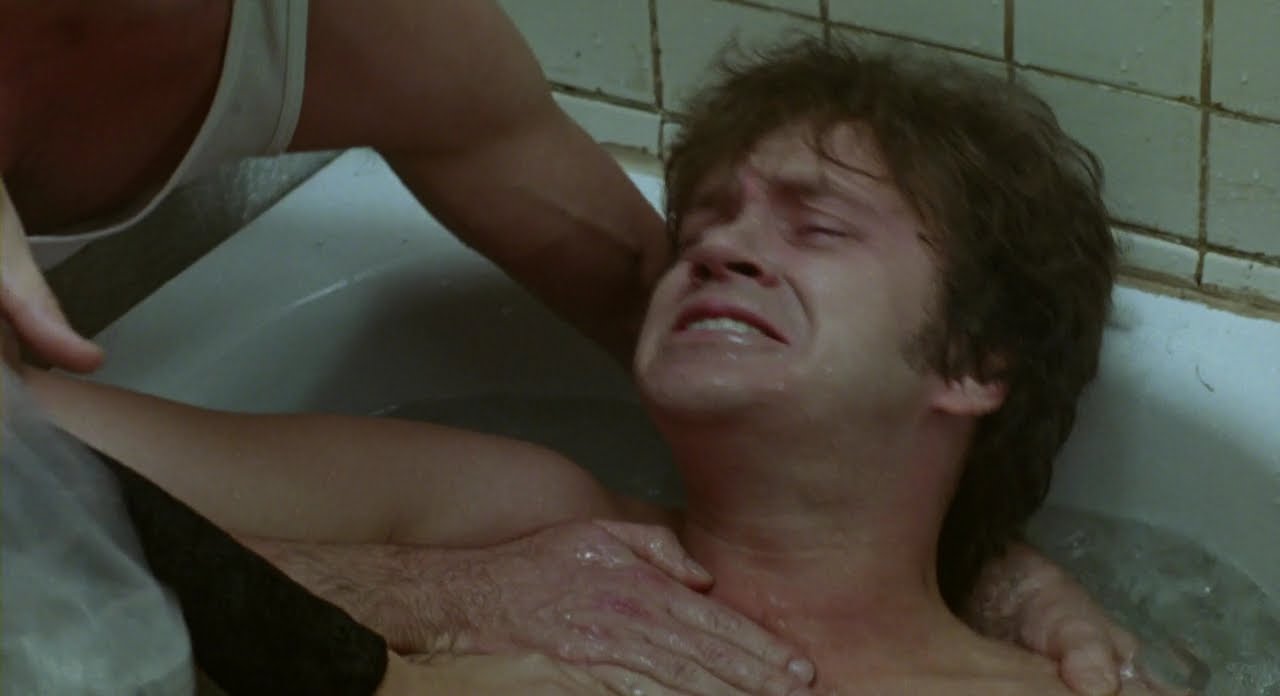
| I felt like Jacob Singer in Jacob's Ladder. |
I addition to my Jacob's Ladder-like nightmare, I was faced with the anxiety of going to a hospital. And with the Rugby Guy gone, there was no real leader to keep me from totally losing my marbles. It was a bit late for that though.
I was shocked and stunned. I couldn't discern how or why I reached the indescribable state I was in.
As I understand, from my psychology degree, the neurotransmitters in your brain need electrolytes (potassium, sodium, magnesium, calcium and I think others) between them in order to both send a signal across a synapse and to prevent signals from continuing to be sent. These signals, I believe, can be between nerves (your brain is pure nerves) or from a nerve to a cell (like a muscle cell).
So when you don't have any electrolytes, the 'wires' get mixed up or stop altogether both in your brain and to your muscles. Either they don't fire or maybe they do but they don't stop! In other words you go bat-shit crazy and you collapse.
Soon I found myself on a bed in the emergency room of some hospital; I had no idea which. I was surrounded by doctors and nurses, trying to figure out what was wrong with me. I was mad. I was confused. I was incredulous. I was delirious. At one point I even said, "This is fun!" I was loco.
"Are you allergic to any medicines?" a doctor or nurse asked.
"How would I know, I haven't tried them all," I sarcastically replied.
"Can you move your arm over?" another attempted.
"Yes," I said, but then didn't move my arm.
"We're going to put a needle in you, OK?" a doctor asked.
"No, I really have a phobia of needles, you can't do it," I insisted.
"But we need to check your blood to see what's wrong with you."
"What's wrong with me, I'm freaking dehydrated, can't you tell!"
"We also need to put this solution in you to give you electrolytes," she said.
I answered, "No needles! Go buy some Gatorade!"
Recovery
She eventually talked me into it, and they put one in each arm. I felt much better almost instantly. It was almost cathartic how the anxiety and horror dissipated into a laughable illusion. My confusion started to clear. I became polite. I apologized to the nurses and doctors. I became rational. My sanity returned.
Not long after that they took me to get a CAT scan to make sure I didn't have a stroke or any brain damage.
 |
| Here's how my brain looked turned to oatmeal |
 |
| I kind of look like Homer Simpson here. Felt like him too. |
 |
Doctor: "This guy's here for some x-rays and stuff. Why don't you just do one of his chest for fun?"
Good thing I have insurance. |
 |
The hospital must have been really broke to want to x-ray my knee just because it had a scratch on it.
Nobody could have really thought it was broken. |
 |
This is the kind of scratch I get regularly when I mountain bike.
To treat it, they covered it in tetracycline, layers and layers of gauze, and a ton of adhesive waterproof covers.
I ripped all that crap off as soon as I got home. |
They also X-rayed my chest (no idea why) and my knee, which had a tiny cut on it. (The cut is cool - it is an imprint of the metal grate we jogged on.) Of course nothing was broken.
.JPG) |
| My kids were happy to visit me in the hospital |
After a few hours, I was taken to my room. There was really nothing to do - my wife brought me a few books and my iPad, and of course my kids visited. Some friends and colleagues visited, which was cool. But more than anything I just needed rest. Lots and lots of rest.
I was there just over 48 hours. Over that period they took my blood and did an ECG every 8 hours, gave me a tetanus shot, and took my blood pressure about once every 30 seconds it seemed.
They put layers and layers of gauze on my knee scrape, in addition to tetracycline, and about a half-dozen clear adhesive plastic water-proofing films. Seriously, the bandages were far more uncomfortable than the cut.
 |
| Fall precaution? What in the world could have ever given them that preposterous idea? |
I had (still have) a giant bump on my head which everybody ignored. I had a headache for three days. And Paracetamol is useless to me.
Heart Rate
I've heard the saying that the only heart rate you need to ever worry about is one that's zero. If this is true, it means you won't hurt yourself by maxing it out. Anybody who uses a heart rate monitor probably has a good idea of what their maximum heart rate is. The common formula is HR = 220 minus your age.
But this so-called formula is only a rough gauge. It was devised in the '70s by a guy named Dr. Haskell and was based on 10 previously-published studies. The subjects in those studies were not representative of the population, and the estimate wasn't meant to be taken too seriously. But it was convenient and it came at a time when athletes and coaches wanted a figure to put to training levels, and technology was coming out that could incorporate these formulae, like treadmills and heart rate monitors.
(Source: NYT article)
So it stuck, and we all seem to use it: 220 minus your age.
Also, we're all different - a friend of mine's heart rate easily hits 190 when he cycles but never goes above 170 when he runs. And he's 41. I, on the other hand, at 38, hit a max of 167 cycling but was recently able to reach 186 running. It doesn't add up. Your real maximum may vary by up to 20 beats per minute from Haskell's casual formula.
So not accurately knowing your maximum may result in you training in the wrong zones, either too high or too low, and not getting the most out of yourself, or overdoing it. And what I find amazing is that my maximum on my bike seems to be different than the maximum when I run. Perhaps my maximum when I swim is different too?
If the saying is true, and that you can't explode your heart from excess exercise, there must be other things that will give out first. For me, it's hydration and nutrition.
Conclusion
As with many emergency or unusual situations, a variety of conditions must be present simultaneously for them to occur. Some of these may be perfectly normal, but in combination, they can be deadly. Any one of these factors on their own wouldn't have had the same result. I'll do my best to list them out below.
1. I am not a trained runner and do not have the experience or physical capacity to achieve what I thought I could. My cycling fitness didn't transfer over to running as easily as I thought it would have. I overestimated myself.
2. I did not drink enough water beforehand or during the race. I had two glasses of water right before the run, and a fraction of one of the small glasses at the second water stop. The first one wasn't even set up by the time I arrived.
3. I did not have enough electrolytes. This would have been fine had I not run so hard. After all, probably the majority of the participants didn't pay any attention to their electrolyte levels, yet they finished.
3.5. And my last one, more like an excuse or a complaint, is the wrong turn I took.
The race crew were not on their toes. They didn't see our urgent need to know which way to go! We don't want to slow down and ask directions; we need to know at least 20-30m in advance so we can plan our line and where we run. One of them was lying on a bench playing on her phone. Another told me to go left when there were two lefts: a paved sidewalk that went into the jungle and a road. I didn't know which to take.
But the worst one was at the top of Mt. Faber where there's a very sharp bend, maybe 120 degrees, which leads back down or up even higher to some kind of monument. The guy just said "go right" but didn't say where, and by the time I had to make the choice he was out of sight.
I decided to err on the safe (hard) side and go uphill, as I remembered they said "to the top" in the pre-race briefing, but all I found was elderly China tourists. I found a stairway down the other side which led me back to the road, but I lost a considerable amount of time and exertion on that one.
I suppose I could have finished just fine had any of one of the first three been resolved. I bet even if I would have overestimated myself, but I had the water, I would have been fine. But believe me, I'll make sure I fulfil at least two out of the three from now on. I think it's fine to overestimate yourself, but now I know you need the proper safety net in place.
I will go back to that course, I will conquer it, and I will do it in a respectable time. It should not be hard given what I have learned.
But most important of all, I have to give all my thanks to the Rugby Guy. I must thank him for:
- Having the selflessness to sacrifice his race finish and position for my health
- Having the leadership to direct others in a time of confusion
- Having the charisma to keep my morale up and get my mind of my pain
I'm trying to track him down and when I do, I'm taking him out for beer. Rugby Guys like beer right?
And if he wants to push himself too hard on the beer, no problem, I've got his back like a stretcher.
---------------------------------
Update
A few days after posting this entry I tracked down the Rugby Guy. His name is Ian, and he's a lawyer. I called him and thanked him for all he had done. Additionally, I got his home address. I ordered a dozen local craft beers to be delivered to his house that night, in appreciation for all he had done. Luckily, he is someone who can appreciate good microbrews.
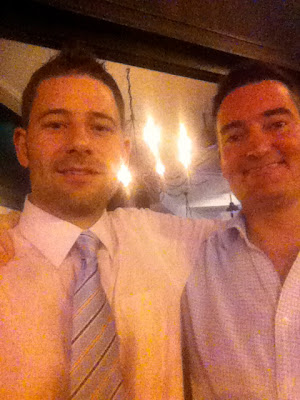 |
| We finally meet |
Then a week after that we finally met up. This was the first time I had seen him, though I felt like I knew him. Over a few more beers, he explained to me how he got the stretcher to me (the organisers had one, and they yelled to the one of the marshals who got it), and a few other missing memories.
Throughout this experience, I learned a lot about my body and my mind, and it has only made me stronger and more prepared for the next race.
Ride hard or ride home.




.JPG)


